
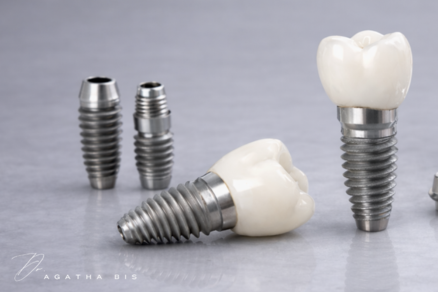
When patients search for “dental implants in Oakville,” they are typically looking for a permanent solution to replace a missing tooth. However, in advanced restorative dentistry, we know that true permanence is not created by a titanium post alone.
A successful dental implant relies heavily on precise diagnosis, adequate bone quality and volume, periodontal stability, and meticulous long-term maintenance. More importantly, it requires a profound understanding of occlusion – how your bite force is distributed. At Smiles by Bis, we do not simply “place” an implant; we engineer it into a highly functional, harmonious system. Implant treatment in our Oakville practice begins with a comprehensive biomechanical evaluation long before any surgery takes place.
What Is a Dental Implant?
Fundamentally, a dental implant is a biocompatible titanium fixture that is surgically placed into your jawbone to act as an artificial root for a missing tooth. Once it has successfully integrated with your natural bone, it can support a custom crown, an implant bridge, or even a full denture.
However, achieving long-term success requires much more than simply achieving osseo-integration (the fusion of bone to titanium). The implant must function seamlessly within your existing bite.
The Most Overlooked Factor in Implant Success: Occlusion
Many patients are surprised to learn that implant failures are often not surgical failures at all; they are force failures.
Unlike your natural teeth, which are suspended by a shock-absorbing periodontal ligament, implants are rigidly fixed directly to the bone. Because they do not absorb force the same way natural teeth do, implants are highly susceptible to damage if they are subjected to excessive biting pressure. Without careful force control and intelligent occlusal design, overloading can occur, leading to destructive bone loss, loosened internal screws, or fractured porcelain crowns.
Before placing dental implants in Oakville, we perform a rigorous evaluation of your entire chewing system, including:
- Your bite pattern and vertical dimension.
- Any signs of parafunction, such as chronic clenching or grinding.
- Existing restorations and enamel wear patterns.
- The health and stability of your temporomandibular joints (TMJ).
Who is a Candidate for Dental Implants?
Implants are an exceptional, fixed long-term solution for patients who have missing teeth, face impending extractions, or desire a reliable alternative to removable dentures.
However, true candidacy depends on a variety of clinical factors, including your available bone volume, your gum health, your biting forces, systemic health considerations, and your smoking status. To accurately assess your bone anatomy before treatment, a CBCT (Cone Beam Computed Tomography) 3D scan is often essential.
Our Precision Diagnostic Protocol
Precision must always precede placement. Our advanced diagnostic protocol includes:
- High-resolution CBCT 3D imaging and digital intraoral scanning.
- Detailed photographic documentation and occlusal analysis.
- A comprehensive assessment of adjacent teeth and opposing dentition.
We utilize a “prosthetically driven” approach to implant dentistry. This means that the ideal position of your final custom crown actually dictates the exact surgical placement of the implant fixture in your jaw—not the other way around.
The Dental Implant Process at Smiles by Bis
Our meticulous process ensures that your implant is engineered for ultimate stability:
- Comprehensive Consultation: We evaluate your full clinical picture, looking far beyond just the missing space.
- 3D Planning: Using your CBCT imaging, we analyze the width, height, and angulation of your bone while mapping the proximity to vital anatomical structures.
- Surgical Placement: The titanium fixture is placed with absolute precision regarding its angulation and restorative positioning.
- Healing Phase: The critical osseo-integration process typically requires 3 to 4 months.
- Final Restoration: A beautiful, custom porcelain crown is fabricated and meticulously adjusted to ensure controlled occlusion.
- Maintenance and Monitoring: Regular professional hygiene and clinical evaluations are critical to protecting your long-term success.
Single Tooth vs. Multiple Implants
Whether you need a single crown, an implant-supported bridge, or a full-arch restoration, each unique scenario requires a completely different force distribution strategy. The sheer number of implants you receive does not determine the strength of your new smile; the biomechanical design determines its strength.
How Long Do Dental Implants Last?
With proper surgical placement, expert force control, and diligent maintenance, dental implants are incredibly durable and can last for decades. However, it is important to remember that while they are durable, they are not indestructible. Their longevity depends heavily on your daily oral hygiene, your smoking status, the stability of your bite, and your commitment to professional maintenance.
Dental Implants in Oakville: Designed for Stability, Not Just Replacement
An expertly placed dental implant should seamlessly restore your chewing efficiency, maintain your bone volume, preserve your facial structure, and support your long-term oral health.
Replacing a missing tooth is a relatively straightforward procedure. Engineering that replacement for lifelong stability is the true difference.
If you are considering dental implants in Oakville, diagnosis determines durability. Contact Smiles by Bis today to schedule your comprehensive implant consultation.
Read blog –Dental Implants vs. Bridges in Oakville: A Structural Comparison
– Written by Dr. Agatha Bis
 Book your cosmetic consultation in Oakville
 Visit us at smilesbybis.com
 Call us at (905) 338-6684