
Losing a natural tooth is a significant biomechanical event that instantly alters the balance of your bite. When a tooth is missing, the surrounding teeth gradually shift, your chewing forces become unevenly distributed, and the underlying jawbone begins to deteriorate.
At Smiles by Bis in Oakville, we understand that replacing a missing tooth is not just about restoring your smile’s appearance; it is about rebuilding your mouth’s structural foundation. When our patients are faced with replacing a single missing tooth, they are usually presented with two primary options: a dental implant or a fixed dental bridge.
While both options effectively restore function and esthetics, their structural implications are vastly different. Understanding these differences is the key to making a long-term investment in your oral health.
The Fixed Dental Bridge: Supported Restoration
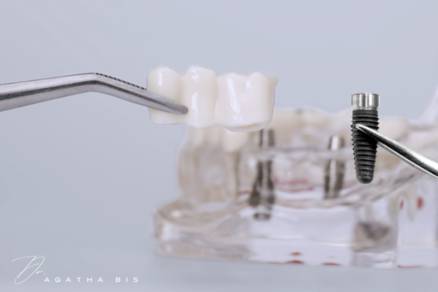
A fixed dental bridge has been a reliable restorative solution in dentistry for decades. It works exactly as the name implies: it “bridges” the gap left by a missing tooth. To place a bridge, the healthy teeth on either side of the empty space are conservatively reshaped and fitted with crowns. These crowns act as anchors, suspending a false porcelain tooth in the middle.
While a bridge is an excellent, highly esthetic way to replace a tooth—especially if the adjacent teeth already need crowns due to large fillings or damage—it does come with specific structural trade-offs:
- Relies on Support Teeth: A bridge does not function independently. The biting force placed on the false middle tooth is transferred directly to the two anchoring teeth, significantly increasing their workload.
- Requires Alteration of Adjacent Teeth: If the teeth on either side of the gap are perfectly healthy and pristine, placing a bridge requires us to permanently grind away healthy enamel to accommodate the anchor crowns.
- Does Not Prevent Bone Loss: Because a bridge simply sits on top of the gums, it does not stimulate the underlying jawbone. Over time, the bone in the missing tooth site will gradually resorb (shrink), which can eventually alter the contour of your gumline.
The Dental Implant: Independent Reinforcement
In advanced restorative dentistry, the dental implant is widely considered the gold standard for tooth replacement. Rather than relying on neighboring teeth for support, a titanium implant post is surgically placed directly into the jawbone, acting as an artificial root. Once the bone fuses to the implant, a custom porcelain crown is attached to the top.
When your bone volume and overall health permit, a dental implant provides a fundamentally superior, independent solution:
- Functions Independently: An implant stands entirely on its own. It absorbs and distributes your bite force directly into the jawbone, exactly like a natural tooth.
- Protects Adjacent Teeth: Because an implant is self-supporting, we do not need to alter, grind down, or crown the perfectly healthy teeth next to the gap.
- Preserves the Jawbone: The titanium root actively stimulates the surrounding jawbone when you chew, preventing bone resorption and maintaining your natural facial structure.
- Superior Longevity: When properly planned, surgically placed with precision, and meticulously maintained, dental implants typically offer a much longer lifespan than traditional bridges.
Our Precision Decision Framework
At Smiles by Bis, we do not believe in a one-size-fits-all approach to restorative care. While implants are often the ideal choice, bridges remain highly appropriate and successful in specific clinical scenarios.
To determine the absolute best solution for your unique smile, we utilize a comprehensive decision framework. Before recommending an implant or a bridge, we rigorously evaluate:
- Bone Availability: Utilizing advanced 3D CBCT imaging to ensure you have enough bone volume and density to support an implant.
- Adjacent Tooth Condition: Assessing whether the neighboring teeth are pristine (favoring an implant) or heavily restored and in need of crowns anyway (making a bridge a viable option).
- Bite Pattern and Parafunction: Analyzing your occlusion and checking for destructive habits like bruxism (teeth grinding) that could affect the longevity of the restoration.
- Long-Term Maintenance Goals: Discussing your commitment to oral hygiene, as both options require specific, diligent home care.
Comprehensive Tooth Replacement in Oakville
Replacing a missing tooth requires a deep understanding of structural engineering, force distribution, and aesthetic harmony. Whether your smile requires the independent strength of a dental implant or the reliable restoration of a fixed bridge, we engineer solutions designed to last.
– Written by Dr. Agatha Bis
 Book your cosmetic consultation in Oakville
 Visit us at smilesbybis.com
 Call us at (905) 338-6684