
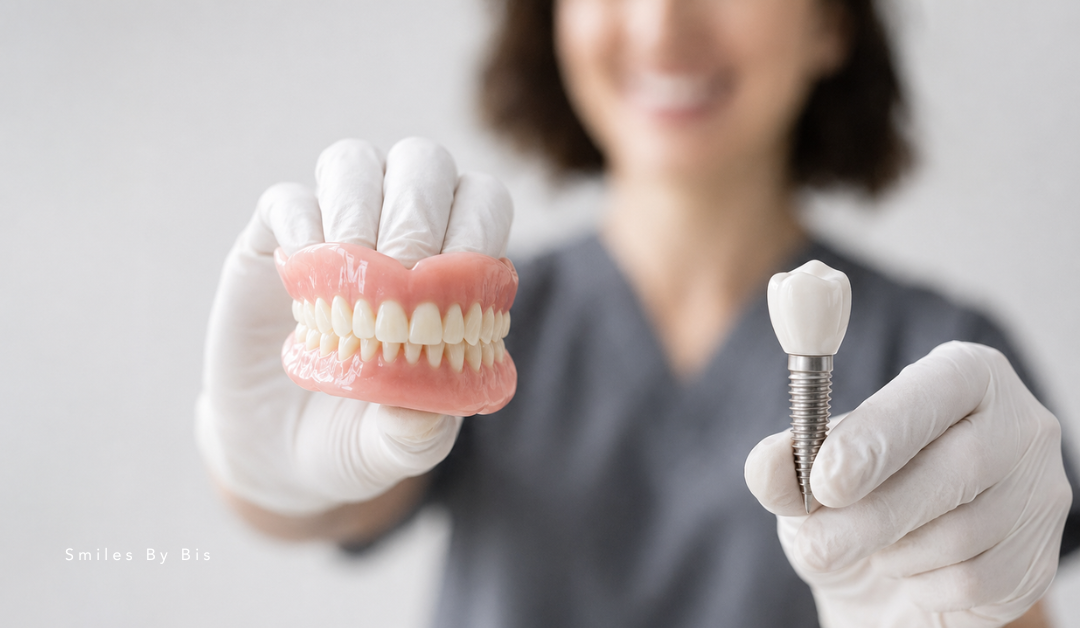
When several or all of your teeth are missing, you may hear two recommendations repeatedly: dentures and dental implants.
So which one is better?
There is no universal answer.
Both can replace missing teeth, but they work differently and involve different treatment, maintenance and anatomical considerations.
Understanding those differences can help you have a more useful conversation with your dentist.
What Are Traditional Dentures?
Dentures are removable prosthetic teeth.
A complete denture can replace an entire arch of missing teeth, while a partial denture can replace several missing teeth.
Traditional complete dentures generally rest on the gums and are removable for cleaning and at night.
For many patients, dentures provide a non-surgical way to replace multiple missing teeth.
What Are Dental Implants?
A dental implant replaces the root portion of a missing tooth with an implant placed into the jawbone.
Once integrated and appropriate for restoration, implants can support an individual replacement tooth, a bridge or a larger prosthesis.
Because implant treatment involves the jawbone, factors such as your general health, gum health and available bone need to be evaluated before treatment.
Dentures vs. Implants: What’s the Difference?
Removable vs. Supported by the Jaw
Traditional dentures are removable and rest primarily on the gums.
Dental implants are placed in the jawbone and provide an anchor for replacement teeth.
Surgery
Traditional denture treatment does not require implants to be surgically placed.
Dental implant treatment involves a surgical procedure and usually requires multiple stages and appointments.
Stability
Because implants anchor a restoration to the jaw, they can provide additional stability. Traditional dentures rely on their fit and the anatomy of the mouth.
Maintenance
Both options require daily care.
Dentures need to be removed and cleaned properly. Dental implants and the restorations they support also need careful cleaning and ongoing dental examinations.
Neither option is maintenance-free.
Cost and Treatment Time
Implant treatment generally involves a larger initial investment and a more involved treatment process than traditional removable dentures.
Cost should be considered alongside your health, anatomy, expectations and long term treatment plan.
What About Implant-Supported Dentures?
The decision is not always simply “dentures or implants.”
Implants can also be used to support a denture.
An implant-supported denture attaches to dental implants rather than relying only on the gums for support. Depending on the design, these prostheses may be removable or fixed.
For some patients, this can provide another option when greater denture stability is desired.
Which Option Is Right for You?
The answer depends on more than preference.
Your dentist needs to consider:
- How many teeth are missing
- The health of your remaining teeth
- Your gums
- The available jawbone
- Your general health
- Your ability to maintain the restoration
- Your treatment expectations
- Your budget and treatment timeline
Sometimes traditional dentures make sense.
Sometimes implants may be considered.
And sometimes a combination provides an appropriate solution.
Start With the Problem, Not the Procedure
Rather than beginning with “I want implants” or “I need dentures,” it can be more useful to begin with:
What needs to be replaced, and what does my mouth need to function well?
From there, your dentist can explain the reasonable options and the advantages and limitations of each.
Tooth Replacement Options in Oakville
If you have multiple missing teeth or are considering replacing an existing denture, a consultation can help you understand your options.
At Smiles by Bis in Oakville, we can assess your oral health and discuss dentures, dental implants and other appropriate tooth replacement options based on your individual needs.
Call 905-338-6684 to book a consultation.