
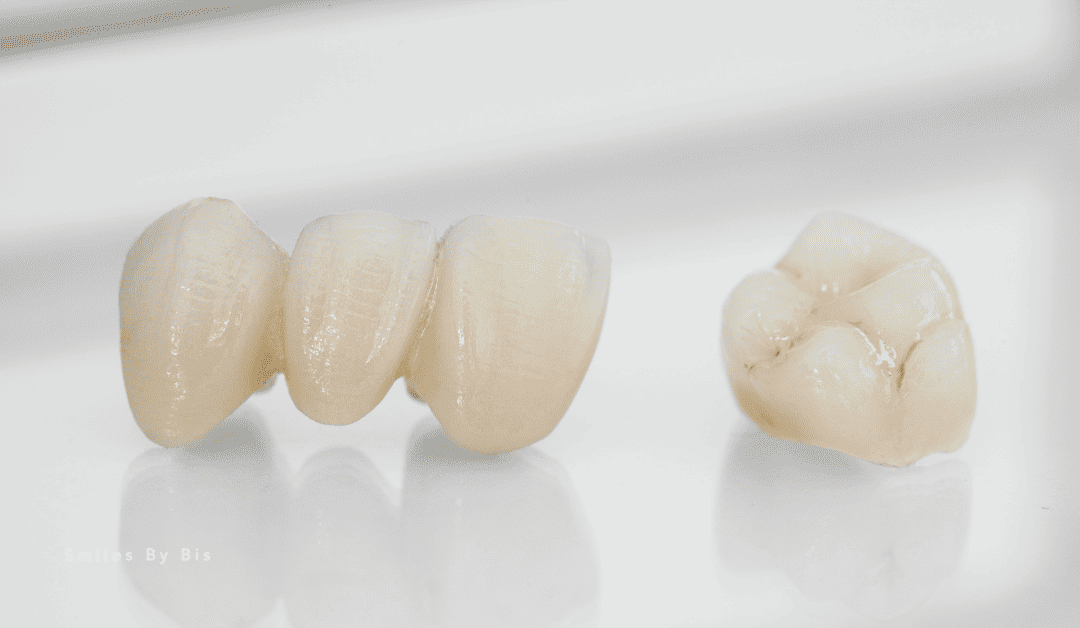
Dental crowns and bridges are often discussed together, but they do two different jobs. A crown usually restores a tooth that is still present.
A bridge replaces a tooth that is missing.
Understanding that difference is the easiest place to start.
What Is a Dental Crown?
A crown covers a damaged or weakened natural tooth.
Your dentist may recommend one when a tooth:
- Has a large filling
- Is broken or weakened
- Has undergone certain root canal treatments
- Has significant structural damage
- Needs greater protection than a filling alone can provide
The natural tooth remains underneath the crown.
What Is a Dental Bridge?
A dental bridge replaces one or more missing teeth.
A traditional bridge commonly uses teeth on either side of the missing space for support.
Those supporting teeth receive crowns, while an artificial tooth between them fills the gap.
The restoration is fixed in place rather than being removed by the patient.
Crown vs. Bridge: What’s the Main Difference?
The simplest distinction is:
A crown restores an existing tooth. A bridge replaces a missing tooth.
However, the two can also work together because crowns may support a traditional dental bridge.
When Might You Need a Crown?
A crown may make sense when the tooth is still present and has enough healthy structure to be restored.
The objective is usually to preserve and protect the tooth.
When Might You Need a Bridge?
A bridge may be considered when a tooth has already been lost or needs to be removed and there is a space to replace.
Replacing a missing tooth can help restore chewing function and prevent some neighbouring teeth from moving into the space.
What About Dental Implants?
A dental bridge is not the only way to replace a missing tooth.
Depending on your oral health, your options may also include:
- A dental implant
- A removable partial denture
- An implant-supported restoration
- In some situations, monitoring the space
One important difference is that a traditional bridge generally relies on neighbouring teeth for support, while a single dental implant can replace a missing tooth independently.
If the adjacent teeth are healthy, this can be an important factor to discuss.
If those neighbouring teeth already require significant restorative treatment, the conversation may be different.
Is a Bridge Better Than a Crown?
This is not really a “better or worse” comparison because the restorations solve different problems.
If the tooth is present but damaged, your dentist may evaluate whether a crown can restore it.
If the tooth is missing, then the conversation moves toward replacement options such as a bridge or implant.
The correct restoration starts with the diagnosis.
Questions Your Dentist Should Consider
Before deciding on treatment, your dentist may assess:
- How much healthy tooth structure remains
- The condition of the neighbouring teeth
- Your gums and supporting bone
- Your bite
- Why the original tooth became damaged or was lost
- The location of the tooth
- Your oral hygiene
- Your long-term treatment goals
This helps avoid making a treatment decision based only on the name of a procedure.
If you have a damaged tooth or are missing a tooth, you may have more than one restorative option.
At Smiles by Bis in Oakville, our dental team can examine the area and explain whether a crown, bridge, dental implant or another treatment may be appropriate.
Understanding the problem comes first. Choosing the restoration comes next.
Call 905-338-6684 to book a consultation