
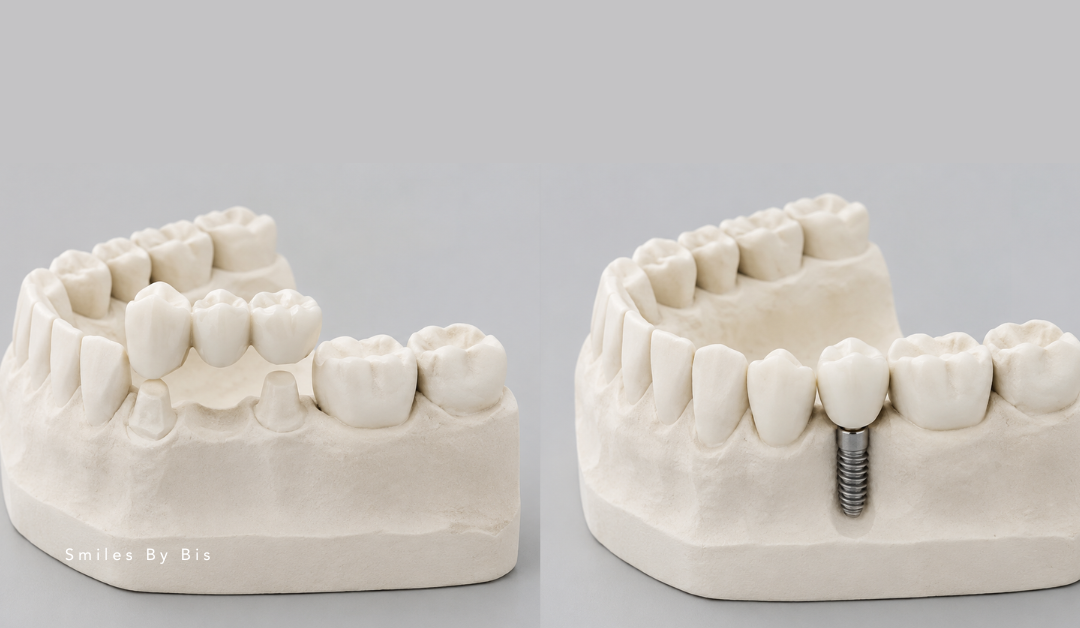
If you are missing one tooth, your dentist may discuss two common replacement options: a dental implant or a dental bridge.
Both can fill the space created by a missing tooth.
But they do it very differently.
Understanding those differences can help you ask better questions and make a decision based on your mouth rather than simply choosing whichever option sounds newer.
What Is a Dental Implant?
A dental implant replaces the missing tooth root.
The implant is surgically placed in the jawbone and, once appropriately healed, supports a replacement tooth such as a dental crown.
One of the important differences is that a single implant generally does not require the natural teeth beside the space to support the replacement tooth.
What Is a Dental Bridge?
A dental bridge spans the space created by one or more missing teeth.
With a traditional bridge, the teeth on either side of the gap are prepared for crowns. These crowns support an artificial tooth positioned between them.
The bridge is fixed in place and is not removed by the patient.
Dental Implant vs. Bridge: What’s the Difference?
Effect on the Neighbouring Teeth
A traditional bridge uses the neighbouring teeth for support, which means those teeth usually need to be prepared for crowns.
A single dental implant can replace a missing tooth independently.
This distinction can be particularly relevant when the teeth beside the missing space are otherwise healthy.
However, if those teeth already need significant restorative treatment, a bridge may be worth considering for different reasons.
Surgery
Dental implant placement requires a surgical procedure.
A traditional tooth-supported bridge generally does not require implant surgery.
For patients who cannot or do not want to undergo implant surgery, a bridge may provide another fixed option.
Bone
An implant requires enough supporting jawbone, or the possibility of creating adequate support through additional treatment such as bone grafting.
A traditional bridge relies primarily on the supporting teeth rather than placing an artificial root in the missing-tooth area.
Treatment Time
Bridge treatment can often be completed more quickly because it does not require the implant to integrate with the jawbone.
Implant treatment frequently takes several months because biological healing is part of the process.
Cleaning
Both treatments require good oral hygiene.
An implant-supported crown needs cleaning around the implant and gum tissues.
A bridge requires cleaning around the supporting teeth and underneath the replacement tooth.
Your dental team can show you the appropriate techniques for whichever treatment you receive.
Longevity
Both implants and bridges can provide years of function when appropriately planned and maintained.
Neither should be viewed as maintenance-free or guaranteed for life.
The health of the supporting tissues, your oral hygiene, your bite and other factors can all affect long-term results.
Is a Dental Implant Always Better?
No.
An implant may have clear advantages in one situation and not be appropriate in another.
For example, your dentist may consider:
- The health of neighbouring teeth
- Available bone
- Gum health
- Medical history
- The location of the missing tooth
- Your bite
- Treatment time
- Cost
- Your preferences
The fact that a treatment is newer or more technologically advanced does not automatically make it the right treatment for you.
What If the Teeth Beside the Gap Already Need Crowns?
This is an important example of why treatment needs to be individualized.
If the teeth beside a missing space are perfectly healthy, preserving them may be an advantage of choosing an implant.
If those same teeth already require significant restorations, however, the discussion may be different.
The condition of the entire area matters.
Which Option Should You Choose?
Start by asking:
Why did I lose the tooth, what condition is the rest of the mouth in, and what does this area need long term?
Then compare the reasonable options.
Your dentist should be able to explain the advantages, limitations and expected maintenance of both treatments before you decide.
Dental Implants and Bridges in Oakville
If you have a missing tooth and are deciding between an implant and a dental bridge, you do not need to make that decision based on internet comparisons alone.
At Smiles by Bis in Oakville, our dental team can examine the space, the neighbouring teeth and your supporting tissues and discuss the tooth replacement options that may be appropriate for you.
Call 905-338-6684 to book a consultation.